ABOUT US
Our Strategy
By 2030, national adaptation plans (NAPs) will be the engine of resilience—shaping budgets, driving smarter investments, and delivering sustained adaptation action that leaves no one behind.
Climate impacts have increased in severity, threatening irreversible losses.
Adapting to these actual and expected impacts is now widely recognized as a critical component of the global response to the climate crisis, yet adaptation efforts so far have typically been incremental, disjointed, and ad hoc.
We need to reset our approach and prioritize long-term systemic change, which calls for good adaptation planning.
The National Adaptation Plan (NAP) process enables countries to identify and address their medium- and long-term priorities for adapting to climate change. It involves:
- analyzing current and future climate change and vulnerability to its impacts
- identifying and prioritizing adaptation options
- implementing these options
- tracking their performance
It also means internalizing lessons around what works—and for whom—so that adaptation actions are more effective, equitable, and sustainable.
Importantly, the NAP process builds the systems and capacities needed to make this whole effort a part of regular development planning and budgeting, instead of a separate exercise.
Over the past decade, adaptation planning has advanced significantly, with almost all developing countries now having a NAP process underway. The challenge now is turning those plans and priorities into concrete measures. Progress is uneven, with implementation lagging, some plans becoming outdated, and persistent capacity and financing gaps constraining action.
It is against this backdrop that the NAP Global Network’s 2025–2030 Strategic Plan is driven by the overarching theme of supporting the transition from planning to implementation.
Progress in NAPs
Since its establishment in 2014, the NAP Global Network has remained focused on working with national governments to put adaptation at the heart of decision making through more effective, inclusive NAP processes.
Specifically, we:
- continuously support national governments to identify and address their medium- and long-term adaptation priorities
- create and sustain networks of experts on adaptation planning through South–South peer learning and exchanges
- generate, synthesize, and share knowledge on the NAP process with audiences around the world
The landscape within which the Network operates has evolved significantly since 2014. The political profile of climate change adaptation has steadily grown in the intervening years, spurred in large part by the 2015 Paris Agreement, which, for the first time, placed adaptation on par with mitigation in the global efforts to combat climate change. The Green Climate Fund (GCF), the world’s largest dedicated climate change fund, opened a financing window in 2016 to support national adaptation planning processes.
Progress has also been seen at the national level. Enabled in part by a rise in the amount of readiness and preparatory support for adaptation planning from the GCF, more than 140 developing countries have undertaken a process to formulate and implement a NAP. This has led to a significant growth in the number of NAP documents submitted to the UNFCCC.
Challenges remain
Despite this progress, adaptation is not keeping pace with the intensity and scale of climate impacts.
In 2025, the World Meteorological Organization’s State of the Global Climate report confirmed that 2015-2025 were the hottest 11-years on record, and in September 2026 the United Nations acknowledged that global temperatures cannot be kept below the 1.5oC threshold agreed upon in the 2015 Paris Agreement.
Every year, the Adaptation Gap Report draws attention to both global progress in adaptation efforts and the disparity between them and what countries, communities, and science are telling us is needed to build lasting climate resilience.
Within this context, the sustained and successful implementation of NAPs becomes even more important. While countries have made progress in developing, implementing, and evaluating their NAP processes, there is much work to be done if their potential is to be fully achieved.
Many areas are in need of urgent support: stronger links to national development planning, more strategic alignment with relevant priorities, such as biodiversity enhancement, disaster risk reduction, peacebuilding, and social equity, making a swift transition from planning to implementation, and measuring the effectiveness of adaptation priorities.
Planning to Implementation
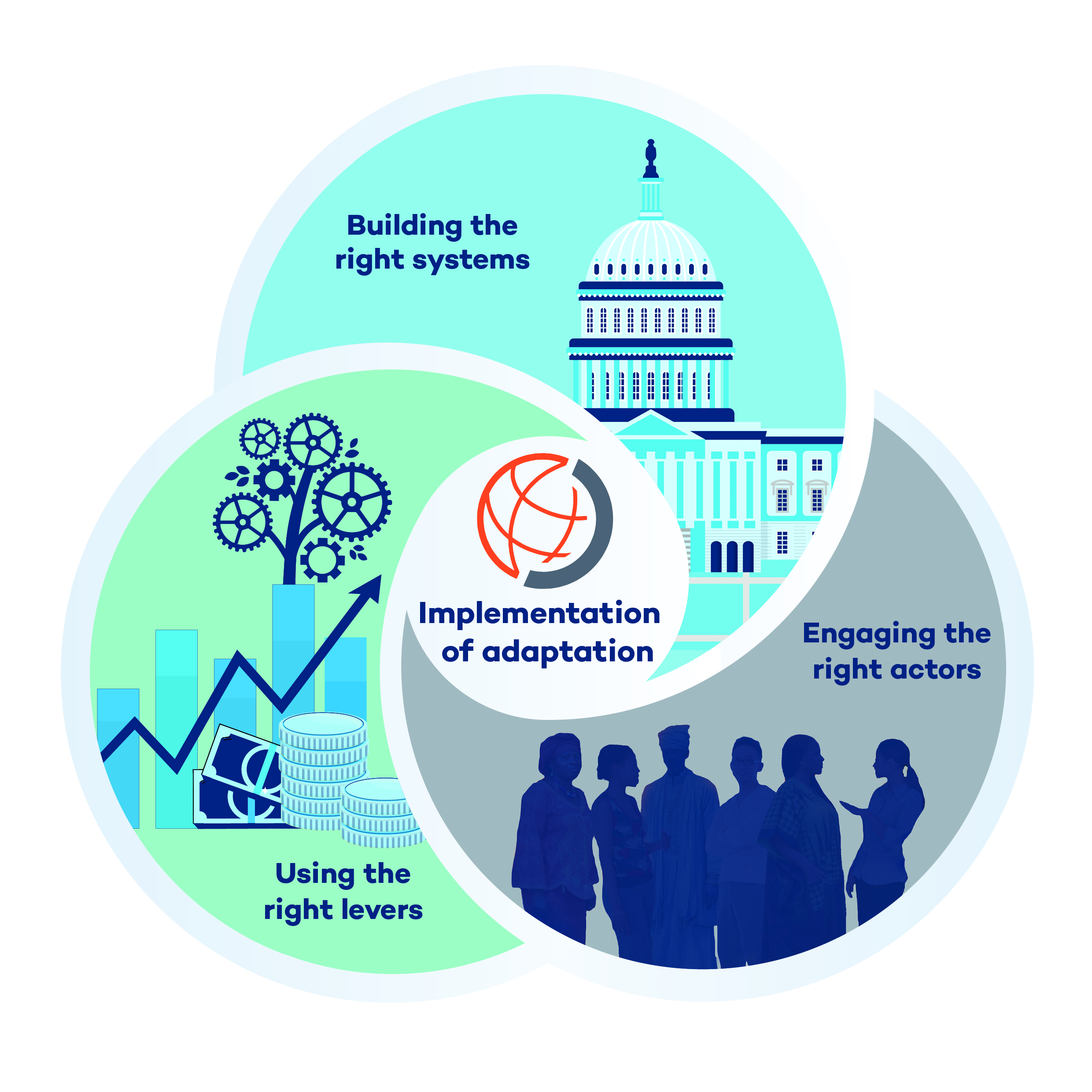
Supporting countries transitioning from planning to implementation is the Network’s priority over the next 5 years, and we will work to accelerate this shift by focusing on three mutually reinforcing approaches:
Building the right systems: strengthening the policies, institutions, coordination mechanisms and evidence systems that underpin adaptation action.
Using the right levers: helping governments mobilize and align financial, economic and market instruments to translate priorities into investment and action.
Engaging the right actors: national and subnational governments, finance and sectoral ministries, civil society, the private sector and others who shape adaptation decisions.
What This Means in Practice
At its core, the Network’s work is about strengthening the human and institutional capacities needed to drive adaptation action—an objective that cuts across all three approaches and lays the groundwork for our activities over the next 5 years.
Deeper Engagement for Sustained Impact
NAP processes are complex and comprehensive, comprised of different phases and a range of actors. They are massive coordination efforts that can be challenging to sustain. After a decade of supporting countries as they navigate this, we see a need for deeper partnerships that allow us to commit to partners in a multi-year, well-resourced program of support.
Flexible Support for Greater Reach
While we deepen our engagement with a smaller group of countries, there are ongoing needs for shorter-term technical support to help ensure NAP processes do not stall. This on-demand support complements bigger existing technical support programs, such as those funded by the Green Climate Fund.
Embedding Technical Capacity for Lasting Change
NAP processes are often coordinated by very small teams of dedicated experts, and human resource gaps are a significant constraint to progress. Embedding technical capacity in government institutions can shift the focus from relying on external—often international—consultants to building lasting national expertise and institutional ownership. This approach strengthens national skills and knowledge and ensures long-term operational support.
Laying the Groundwork for Inclusive Decision Making
Civil society organizations (CSOs) play a critical role in influencing policy decisions, providing services that build resilience and facilitating collective action to manage climate risks, particularly at the local level. However, civil society actors may lack access to adaptation decision-making spaces, meaning that important perspectives are excluded from NAP processes. Through demand-driven support and a collaborative approach, we can provide much-needed technical and financial resources that strengthen CSO capacities to engage meaningfully in NAP processes.
Connecting Peers to Accelerate Progress
South–South peer learning creates opportunities for policy-makers and practitioners to draw inspiration from other countries and build relationships they can rely on as they navigate the complexity of NAP processes. We will build on our success in this area through dedicated geographic cohorts that sustain relationships and continued exchange over time, alongside smaller peer exchanges focused on shared challenges and practical implementation experience.
Translating Learning for Effective Action
We are the leading, go-to knowledge platform and resource on NAPs. Over the next 5 years, we will continue to synthesize learning and track trends while working with NAP teams and other partners to co-produce knowledge, train adaptation actors, and communicate insights. The Network will also continue to advocate for NAPs in the UN Framework Convention on Climate Change and other spaces because we believe there is a pressing need to shift toward a more systemic, anticipatory approach to managing increasing climate impacts. We need to see that urgency reflected in global policy discussions.
find out more
Strategic Framework: Planning to Implementation
More on how the NAP Global Network intends to accelerate the transition from planning to implementation.
Our Strategy to 2030
Read the NAP Global Network’s 2025–2030 Strategic Plan in full.
Progress and Learning Report 2025
Our eighth annual progress and learning report highlights the Network’s activities and achievements.