OUR WORK
Planning to Implementation
Adaptation planning has gained momentum, but translating commitments into action is not keeping pace.
Almost all developing countries have a NAP process underway. The challenge now is to turn these plans into results.
Many countries face similar delivery gaps. Priorities may be clear but not yet costed. Ministries may agree on the broad agenda but not on who is responsible for delivery. Project ideas may exist but not yet be ready for financing. Civil society and private sector actors may have been consulted but still lack a defined role in implementation. Governments may also lack the systems needed to know whether adaptation is reducing risk over time.
Closing these gaps requires more than a good plan: countries need stronger systems for coordination and accountability; financial and economic levers that turn priorities into investment and action; and sustained engagement across government, the private sector, and civil society.
Adaptation finance remains far below what countries need—the imperative is to turn national adaptation priorities into sustained implementation at the pace and scale required.
Our Approach
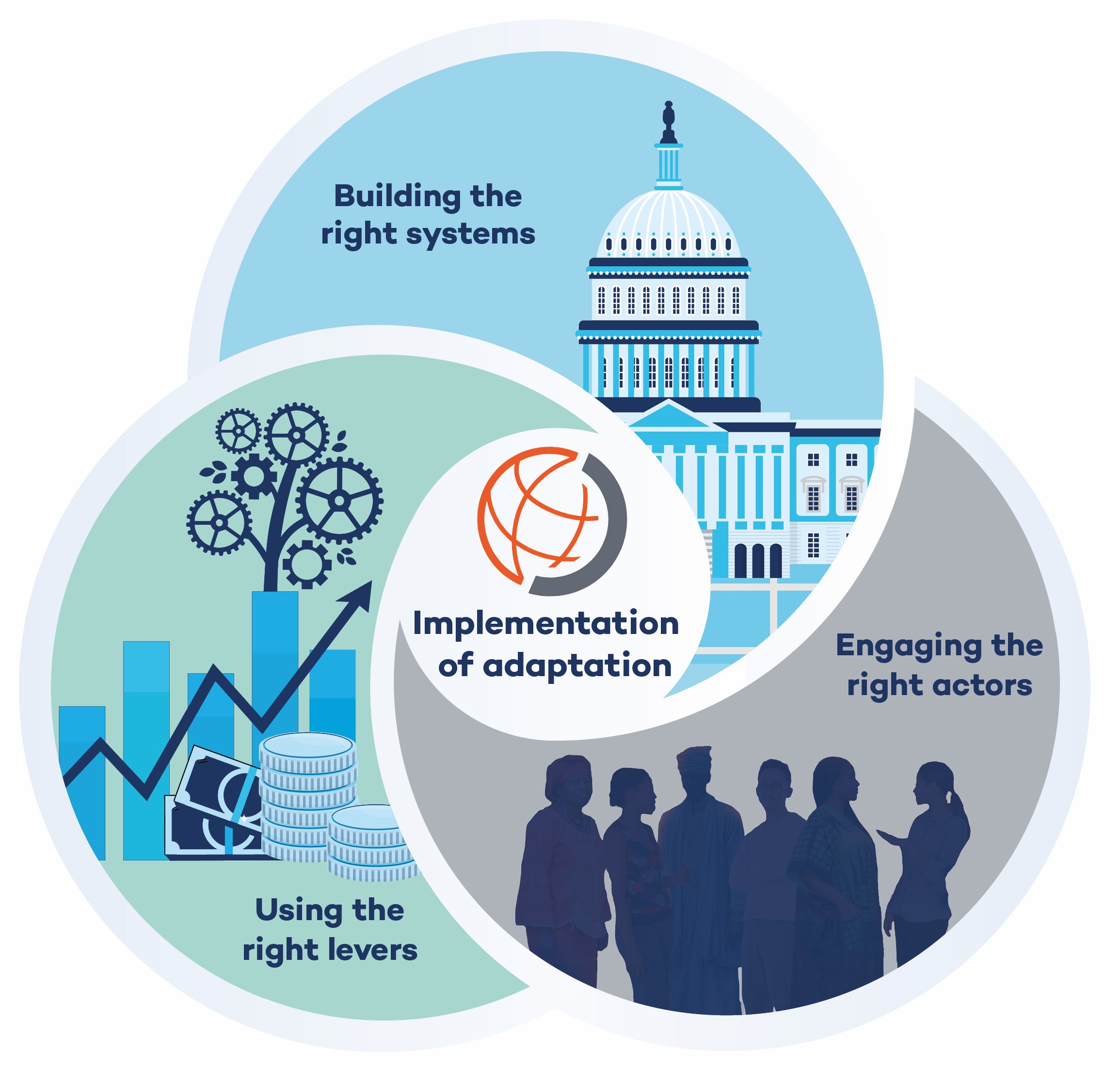
Over the next 5 years, we will accelerate the shift from planning to implementation by focusing on three mutually reinforcing approaches: building the right systems, using the right levers, and engaging the right actors.
- Building the systems needed for implementation. Strengthening the critical foundations that are needed to accelerate and sustain adaptation action over time. These include strengthening coordination across ministries and levels of government; integrating adaptation into policies, development plans and budgets; improving monitoring, evaluation and learning; and clarifying roles and responsibilities for implementation.
- Using the levers that turn priorities into action. Helping governments cost and prioritize adaptation measures, develop investment strategies and pipelines, engage ministries of finance and financial institutions, and use public finance, private investment, trade and other economic tools to support implementation.
- Engaging the actors who need to deliver adaptation. Bringing together sector ministries, ministries of finance, subnational governments, the private sector, civil society and frontline groups so that adaptation priorities reflect diverse perspectives and can be translated into equitable action.
Our Partners in Action
The NAP Implementation Alliance (NIA) was launched at COP30 in 2025 under the Global Climate Action Agenda, in partnership with UNDP, Italy and Germany, and in collaboration with the NDC Partnership and the NAP Global Network, to help accelerate the implementation of National Adaptation Plans. The Alliance brings together national and subnational governments, multilateral institutions, multilateral development banks, vertical funds, investors, insurers, philanthropies, technical support providers, think tanks, research institutions, civil society organizations, and other private sector stakeholders to strengthen collaboration, improve coordination and help countries move from adaptation planning to implementation.
By creating stronger connections across the global adaptation ecosystem, the Alliance aims to help countries access the technical support, partnerships and financing needed to deliver adaptation priorities at scale.
The NAP Global Network and The Asian Development Bank also collaborate to support developing countries in strengthening climate resilience through NAP and climate adaptation investment planning processes. Adaptation investment planning is a critical component of the journey to implementation. Through joint initiatives, including the Climate Adaptation Investment Planning (CAIP) Newsletter, peer learning events, and knowledge-sharing resources, the partnership helps countries translate adaptation priorities into investment-ready projects and mobilize financing for climate change adaptation.
Climate Adaptation Investment Planning: Lessons Learned
This report explores how developing countries can translate their climate change adaptation goals into investment-ready programs that incorporate public and private financing, generate strong economic returns, and help drive development benefits.
adaptation investment planning
CAIP Newsletter
Featuring publications, tools and frameworks to support countries and partners accelerate their implementation efforts, as well as showcasing success stories and progress from countries working to scale up implementation of adaptation investments.
In FOCUS
Climate Adaptation Investment Plans
Climate Adaptation Investment Plans (CAIPs) are country-led frameworks that convert adaptation priorities into sequenced, costed, and investable packages of adaptation measures. Climate adaptation investment planning is part of a country’s NAP process.
Bhutan
Bhutan’s CAIP for the Water Sector translates water-sector adaptation priorities into investment packages covering integrated water resources management, flood risk management, climate-resilient water systems, and early warning services.
Nepal
Nepal’s CAIP for the Madhesh Province focuses on the climate-resilient food systems by bundling interventions across the agricultural value chain into investable packages that can attract financing.
Palau
Palau’s Climate Adaptation Investment Framework (CAIF) provides a methodology for grouping adaptation measures into state-level and thematic investment portfolios that support resilience in areas like housing, water security, connectivity, and public infrastructure.
featured resources
From Planning to Financing
Helpful resources and publications from the NAP GN on translating national adaptation priorities into finance-ready investment pipelines.
Finance for National Adaptation Plan Processes: What can we learn from countries’ national adaptation plans?
Financing is an important enabling factor for effective, inclusive NAP processes. This review of 59 multi-sector NAP documents sheds light on how countries are addressing adaptation finance issues. The report also highlights good practices and identifies areas for improvement to better support countries in identifying, prioritizing, and mobilizing adaptation finance.
Climate Change Adaptation Investment Plans: Frequently asked questions
To bridge the global adaptation financing gap, it is crucial to access a diverse array of funding sources, including domestic, international, public and private sources and financing instruments. Climate change adaptation investment planning offers a structured approach to unlocking these financial resources and accelerating the transition toward implementing countries’ adaptation priorities.
Inventory of Innovative Financial Instruments for Climate Change Adaptation
Private finance to support the adaptation needs of developing countries can be unlocked using innovative financial instruments. This inventory provides information on a range of instruments that have been used, or potentially could be used, to finance the implementation of climate change adaptation measures, including the national priorities identified in National Adaptation Plans (NAPs).