On Friday, November 13, 2026, the Government of Nigeria formally unveiled its National Adaptation Plan (NAP) during a side event at the Climate Mobility Pavilion at the 31st UN Climate Change Conference (COP 31) in Antalya, Türkiye.
Co-hosted by Nigeria’s Federal Ministry of Environment and the NAP Global Network, in collaboration with the Global Centre for Climate Mobility, the launch session brought together government leaders, development partners, and financing institutions to mark Nigeria’s shift from adaptation planning to implementation and investment mobilization.
Presenting the country’s NAP, Nigeria’s Minister of Environment, Balarabe Abbas Lawal, underscored the urgency of coordinated action to protect vulnerable communities from escalating climate impacts. He pointed to severe pressures across every region of the country, including rapid desert encroachment and the shrinking of Lake Chad in the north, gully erosion across central and southeastern states, and coastal erosion and mangrove loss in the south. Noting how climate-driven livelihood loss increasingly fuels displacement and insecurity, Minister Lawal called on international partners to help turn Nigeria’s adaptation priorities into action on the ground.
“Our vision is clear: a Nigeria that not only adapts to climate change but thrives in the face of it. We invite all stakeholders to join us in this endeavour, bringing their expertise, resources, and commitment to the table. Together, we can transform our strategies into action, ensuring a sustainable future for all Nigerians.”
Balarabe Abbas Lawal, Minister of Environment, Nigeria
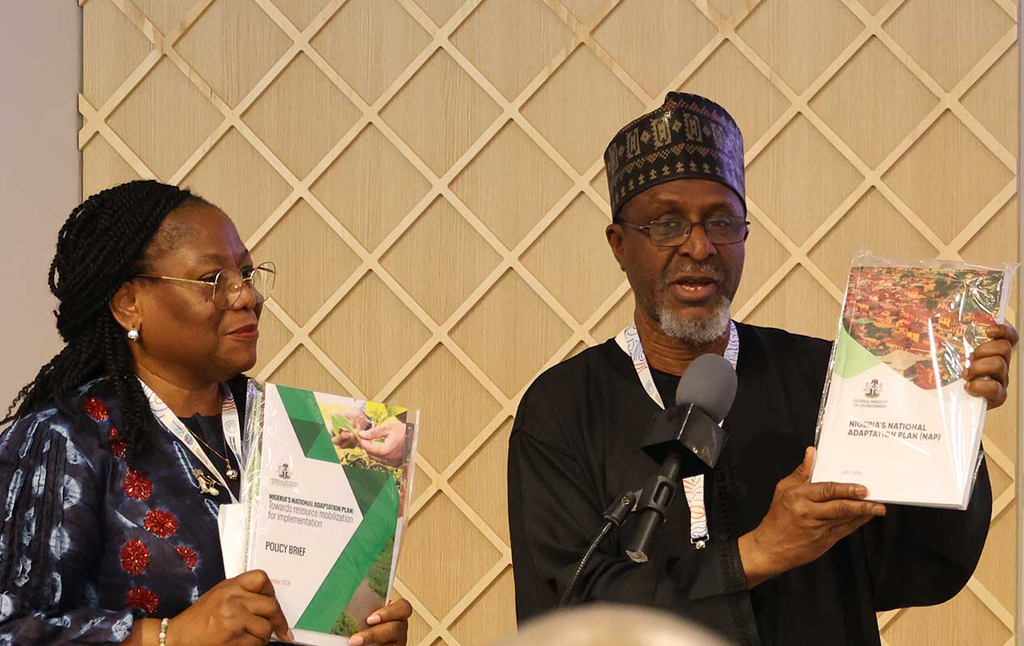
Director Iniobong Abiola-Awe of the Federal Ministry of Environment’s Department of Climate Change outlined Nigeria’s multi-year NAP formulation journey, which began in September 2021 with support from the Green Climate Fund Readiness Programme and the United Nations Environment Programme (UNEP) as delivery partner. She highlighted that the plan is grounded in participatory climate risk and vulnerability assessments across Nigeria’s agro-ecological and geopolitical zones, economic appraisals showing a positive benefit-cost ratio for adaptation investments, and nationwide socialization with traditional leaders and local communities.
Following approval by the Federal Executive Council, Nigeria officially submitted the NAP to the United Nations Framework Convention on Climate Change.
During her presentation, Dr. Iniobong Abiola-Awe recognized the technical assistance and support provided by the NAP Global Network, including the development of a NAP Framework, a gender analysis to inform the country’s NAP process, Nigeria’s Adaptation Communication, and integrating conflict sensitivity and peacebuilding into Nigeria’s NAP process. This support, alongside partners including the Global Centre for Climate Mobility and the Food and Agriculture Organization of the United Nations, strengthened the country’s efforts in advancing the NAP process.
“Nigeria has signalled to the world its commitment to climate resilience. This costed blueprint is intended to protect lives, livelihoods, and the national economy from severe climate shocks such as southern flooding and northern desertification—which are projected to cost the country up to 30% of its GDP (or USD 460 billion) by 2050. Embedding this plan mainstreams the NAP process and puts adaptation at the heart of decision making.”
Orville Grey, Head of the Secretariat for the NAP Global Network
This session also facilitated an investment dialogue and helped identify remaining gaps going forward.
Dr. Grey joined Minister Abbas Lawal and partners on stage to commemorate the document’s release. With a companion policy brief and project concept notes already in place, Nigeria is now focused on mobilizing public and private investment to deliver adaptation measures across key sectors, including agriculture, water resources, energy, health, transport, forestry, and infrastructure.
Minister Lawal also thanked the UNEP, the International Organization for Migration, the GCF, and the other partner organizations mentioned earlier for their technical and financial contributions.