What are the sources of finance and types of financial instruments that should be considered in an adaptation investment plan?
-
How can countries increase domestic resource mobilization as part of adaptation investment planning?
Countries will need to mobilize domestic adaptation finance, as relying solely on public international funding is likely to be insufficient to ensure the implementation of their adaptation investment plans. Mapping the fiscal space for adaptation and identifying effective strategies to increase domestic resource mobilization are crucial steps here.
According to Readhead et al. (2024), different avenues are possible to effectively mobilize domestic resources for climate change adaptation, including:
- Strengthening domestic taxation can make the tax system more effective in capturing revenue from the extraction and use of natural resources like minerals, oil, gas, and timber; reviewing and reorganizing existing tax incentives can ensure they are efficient, effective, and aligned with policy goals; and, broadening the tax base through mechanisms like a value-added tax, property taxes, and potentially wealth taxes is also beneficial.
- Implementing environmental tax reforms, such as carbon taxes, and removing fossil fuel subsidies can generate revenue or save resources while promoting sustainable practices. However, these reforms must be tailored to the specific political and economic context.
- Enhancing the efficiency of public procurement processes can reduce costs and free up resources for adaptation investments.
- Developing robust domestic debt markets, supported by a strong institutional investor base, can provide steady demand for project bonds that finance sustainable infrastructure and other adaptation projects.
- Providing practical guidance on the appropriate package of measures, sequencing, and hierarchy of reforms is vital to ensure effective implementation and maximize the impact of domestic resource mobilization efforts.
It is important to recognize that some developing countries may not be in a position to prioritize these efforts to increase domestic adaptation finance. Therefore, a tailored approach that considers their unique challenges and limitations is essential when identifying the most appropriate sources of funding for climate change adaptation.
-
What international sources of finance can countries access for climate change adaptation?
Countries can access a variety of international sources of finance for adaptation. Under the UNFCCC, key sources include the Green Climate Fund, the Global Environment Facility (which administers the Least Developed Countries Fund, the Special Climate Change Fund, and the Adaptation Fund). Outside the UNFCCC, multilateral development banks, development finance institutions (e.g., the International Finance Corporation), and bilateral cooperation from countries provide significant support for climate change adaptation. These sources typically offer technical assistance and utilize diverse financial instruments, such as grants, loans, equities, or credit risk guarantees.
Countries should identify the most appropriate international sources of finance for their adaptation investment plans based on various factors, including the alignment of funding sources with the country’s adaptation priority investments, historic collaboration with potential funding sources, or the eligibility and accessibility criteria of each funding source.
-
How can the private sector be engaged as a source of funding for adaptation investment plans?
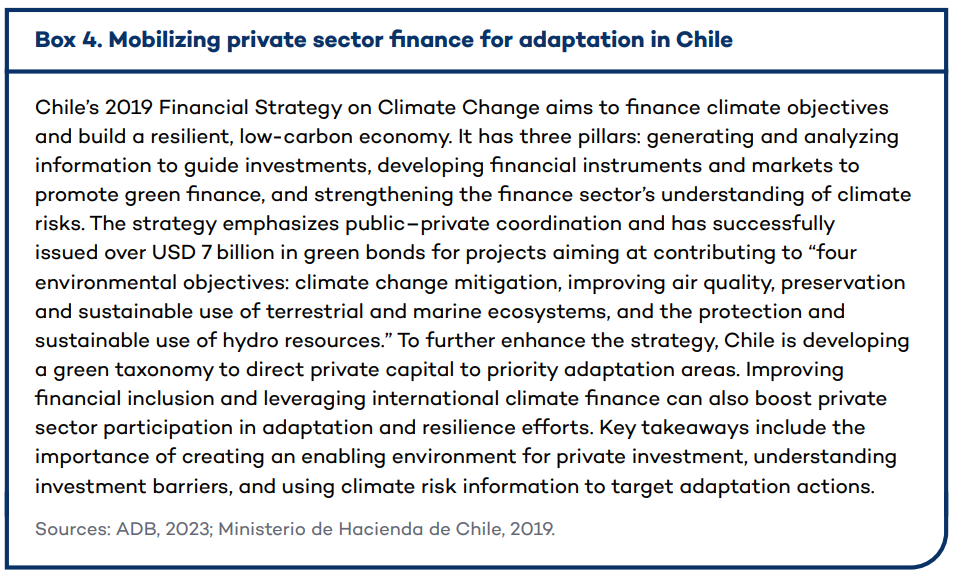
Engaging the private sector from the outset of the adaptation planning processes is crucial for ensuring its effective involvement in mobilizing finance. Key strategies include raising awareness about the importance of adaptation investments, using climate risk assessments to inform the selection of the most appropriate adaptation investments, building the case for these investments by demonstrating how they can avoid costs and generate revenue, and implementing de-risking mechanisms, such as blended finance or credit risk guarantees. Additionally, using fiscal policies and regulations can enhance private sector investments, while establishing institutional frameworks can encourage and facilitate private sector investment in adaptation (i.e., public–private partnership frameworks).
The “private sector” is diverse, encompassing micro, small, and medium-sized enterprises(MSMEs), large corporations, financial institutions, etc. Each country must understand which segment of the private sector it is targeting, identify barriers to private sector engagement in adaptation finance, and determine the most suitable approaches for these entities to invest in priority adaptation investments for the country.
-
What types of financial instruments can countries use to fund priorities in their adaptation investment plans?
Different financial instruments can be mobilized to unlock adaptation finance, including the following:
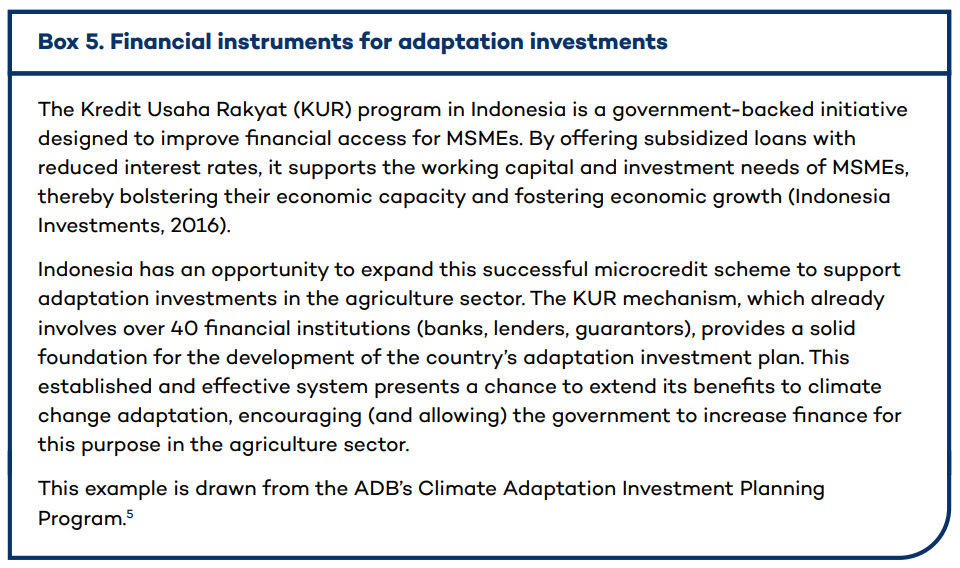
- Grants provide non-repayable funds, while concessional loans offer repayable funding with favourable terms to support large-scale adaptation projects.
- Equity involves investment in exchange for ownership stakes, aligning investor and project interests.
- Bonds, including green, climate, or resilience bonds, raise capital from investors to finance environmentally sustainable and adaptation projects.
- Debt-for-nature or debt-for-climate swaps allow countries to reduce debt in exchange for commitments to invest in conservation or climate change adaptation.
- Guarantees reduce investment risks by ensuring repayment in case of default, encouraging private sector participation. Insurance products protect against climate related losses, providing financial security and encouraging investment in resilience measures.
- Finally, blended finance combines public and private funds to leverage additional resources and reduce risks, making adaptation projects more attractive to private investors.
The NAP Global Network has created an inventory of innovative financial instruments for climate change adaptation to help bridge the gap between available financing and the needs of developing countries (Gouett et al., 2024).
⁵ S. M. Gonzales, ADB, personal communication, March 13, 2025.