
Facing some of the highest climate vulnerabilities in the world, including recurrent hurricanes, droughts, floods, and soil erosion, Haiti took a major step forward in January 2023 with the official submission of its national adaptation plan (NAP) to the UN Framework Convention on Climate Change.
Aligned with the National Climate Change Policy (and the Nationally Determined Contribution (NDC, 2021) documents, the 2022–2030 plan sets out 340 measures, including 21 priority actions across four key sectors: agriculture, health, infrastructure, and water resources.
“The implementation of the NAP represents a nationwide undertaking that requires substantial resources and rigorous monitoring,” emphasized Ms. Gerty Pierre, director of the Climate Change Directorate at the Ministry of Environment.
In this context, a national monitoring, evaluation, and learning (MEL) framework was developed in 2025 through a partnership between the Ministry of Environment and the NAP Global Network, with support from Irish Aid. Led by consultant Dr. Constantin Joseph, an agronomist engineer, the framework aims to provide Haiti with a coherent system to track progress, capture learning, and strengthen accountability in adaptation.
A Participatory and Inclusive Approach
The MEL framework was designed through a participatory approach that combined technical expertise with stakeholder engagement. An in-depth diagnostic of existing practices revealed strengths, such as the Environmental Information System (SIE-Haiti), and gaps, such as the lack of a harmonized legal framework, weak institutional coordination, and financial dependency on external funding.
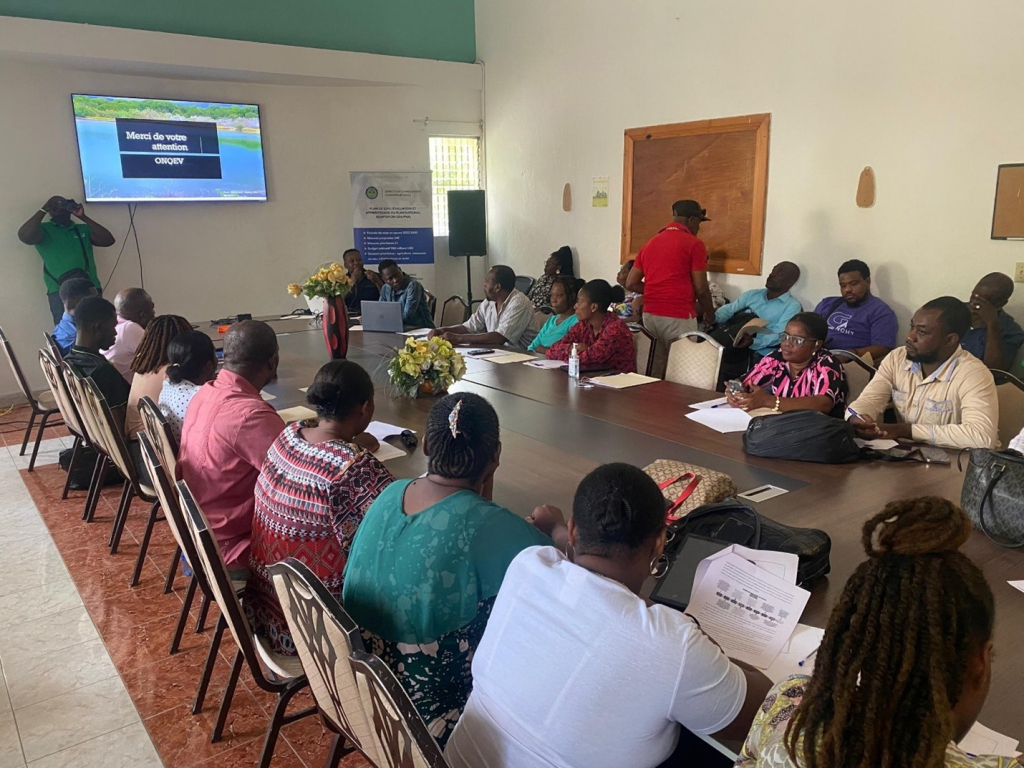
Between May and July 2025, four multistakeholder workshops brought together 161 participants in Port-au-Prince, Cap-Haïtien, Les Cayes, and Fond-des-Nègres. These sessions enabled the co-development of the framework’s structure with contributions from ministries, local authorities, universities, community organizations, and development partners.
“The approach combined technical expertise and social dialogue,” explained Dr Constantin Joseph, agronomist engineer and lead consultant for the development of Haiti’s NAP MEL framework. “Each workshop actively engaged participants in selecting priorities and indicators.”
Measuring What Matters for Adaptation on the Ground
One of the main outcomes of the process was the identification of a core set of measurable indicators (10 per sector), selected for their relevance, feasibility, and data availability:
- agriculture: share of farms using drought-tolerant seeds, proportion of land protected against erosion, number of households affected.
- health: cases of vector-borne diseases (malaria, dengue), climate-resilient health facilities, coverage of early warning systems.
- infrastructure: damaged buildings, annual damage costs, urban plans integrating adaptation.
- water resources: river flow during dry seasons, rainwater-harvesting systems, proportion of households using water-saving techniques.
The indicators are disaggregated by gender, age, and territory to ensure inclusive and equitable monitoring.
Who Does What: A clear governance structure
The MEL framework is based on a multi-level governance structure, which includes
- the National MEL Steering Committee, under the authority of the Ministry of Environment, responsible for strategic guidance and resource mobilization;
- the Technical MEL Unit, housed within the Climate Change Directorate, in charge of coordination, data collection, and training of sectoral focal points; and
- sectoral and territorial focal points, responsible for gathering field-level information and feeding it into the national system.
This architecture promotes two-way information flows, ensuring that field data directly inform policy decisions.
Lessons Learned and Future Outlook
The process confirmed the value of a participatory and adaptive approach. The workshops served not only as planning sessions but also as opportunities for training and awareness-raising platforms on monitoring, evaluation, and climate-resilience principles. Throughout the discussions, the SIE-Haiti system was identified as the central data platform, key to transparency and progress tracking
Challenges remain, however, including the absence of a coherent legal framework, continued reliance on external financing, and the need to strengthen institutional capacities. Nevertheless, the process has laid the foundations for sustained collective learning.
An Ambitious Roadmap to 2030
The implementation of the MEL framework follows a phased roadmap:
- 2026: finalization of indicators, adoption of legal framework, training of focal points.
- 2027–2028: rollout of digital tools and publication of the first MEL reports.
- 2028–2029: national scaling-up and annual learning forums.
- 2029–2030: external evaluation and integration into post-2030 planning.
“The MEL framework reflects a shared conviction: adaptation can only succeed if it is understood as a living, participatory, and evolving process,” emphasized Eng. Hugo Coles, coordinator of the Technical Secretariat of the Directorate-General (STDG) of the Ministry of Environment.
Toward Collective Resilience
With its MEL framework, Haiti now has a strategic instrument for governance and transparency, which is essential for tracking NAP implementation and reinforcing accountability to citizens and partners alike. By combining technical rigour, inclusion, and collective learning, the country is laying the groundwork for lasting and shared climate resilience.
Explore the complete MEL Framework for Haiti’s National Adaptation Plan here.
Authors: Dr. Constantin Joseph, agronomist engineer and lead consultant for the development of Haiti’s National Adaptation Plan (NAP) Monitoring, Evaluation and Learning (MEL) Framework, and Krystel Montpetit, senior policy advisor in MEL for Climate Change Adaptation, NAP Global Network.