Online Course on Gender Equality and Social Inclusion in National Adaptation Plan Processes
Climate change doesn’t affect everyone equally, yet national adaptation plans (NAPs) are often outlined as if it did.
While most countries’ NAPs identify women as particularly vulnerable to climate change impacts, only 16% position them as agents of change in adaptation processes. There is also limited mention of the differential impacts that climate change has on people of various ages, genders, sexual orientations, ethnicities, classes, and other social groups.
These figures reveal a stark reality: decision-making remains unequal—especially in the face of climate change. But how to shift this trajectory and foster a more inclusive and gender-responsive NAP process in your own country?
The NAP Global Network’s self-paced online course will help you strengthen your own work by unpacking how gender equality and social inclusion (GESI) components are integrated in the NAP process. It will also demonstrate why inclusion is essential for effective adaptation planning and how institutions and decision-making structures shape outcomes, supporting more gender-responsive and socially inclusive NAP processes.
This journey is set in Temari, a fictional country that mirrors real-world realities of those most vulnerable to the impacts of climate change. Through its diversity, institutional complexities, and climate change challenges, you will explore how inclusive adaptation planning unfolds in practice.
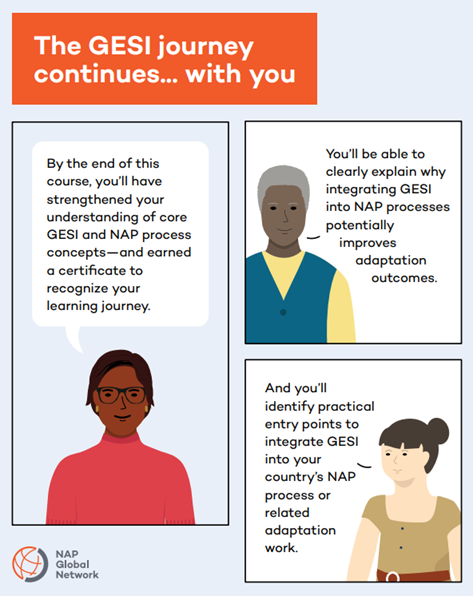
By the end of this course, you will have
- Identified key concepts of GESI and the NAP process
- Gained a clear understanding of the importance of integrating GESI in the NAP process
- Recognized how inclusive and gender-responsive approaches enhance the effectiveness and sustainability of adaptation actions
- Discovered practical ways to integrate GESI using real tools, methods, and entry points.
Syllabus
- Intro Module – The Learning Journey Begins
- Module 1: Understanding adaptation and GESI concepts
- Module 2: The NAP Process: Its Phases and Enabling Factors
- Module 3: Why and How GESI Are Integrated into the NAP Process
- Module 4: GESI Integration in Practice
- Module 5: Integrating GESI into NAP Processes
- Final: Synthesis and Closing
This self-paced course launches in June 2026.
Fill out the form below to receive a notification as soon as this resource is available.
Publisher: International Institute for Sustainable Development (IISD)