Analysis and commentary on the Network’s experiences coordinating climate-resilient development.
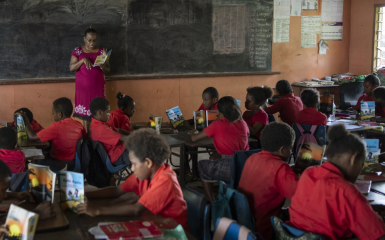
Why the Education Sector Matters in the National Adaptation Plan Process: New resources for NAP teams and education ministries
Climate change is already closing schools, disrupting learning, and placing the education of millions of children at risk every year. Climate change impacts destroy and damage education infrastructure and threaten the safety, health, and well-being of students and teachers, while extreme heat affects concentration and learning outcomes, leaving the most fragile education systems disproportionately at risk. In 2024 alone, 242 million students from pre-primary to upper secondary had their […]

Climate Change Adaptation and Peacebuilding Keep Missing Each Other
In fragile and conflict-affected contexts, climate change and conflict reinforce one another. They do so not in simple or automatic ways, but by interacting with existing political, social, and economic vulnerabilities. Climate impacts affect livelihoods, resource access, and governance systems. Conflict and weak institutions undermine the effectiveness of climate change adaptation. Addressing this dual burden […]
From Country Priorities to Global Signals: A step-by-step guide to adaptation indicators for national monitoring, evaluation, and learning systems
By Emilie Beauchamp and Krystel Montpetit
Countries left the Bonn Climate Change Conference last week without an agreement on issues related to the global goal on adaptation. This stalemate was partly due to disagreement among countries over the next steps and the composition of a task force to improve the Belém Adaptation Indicators (BAIs), the 59 voluntary indicators adopted at the […]

Seven Principles for Effective Civil Society Engagement in National Adaptation Plan Processes
Engagement is an important enabler for the national adaptation plan (NAP) process, helping to ensure that adaptation decision making is informed by diverse perspectives and that the priorities identified are robust and equitable. Civil society actors are key—they bring knowledge, networks, and perspectives that are needed for effective adaptation. In this analysis, we share some new thinking on civil society engagement in NAP processes.

Climate Change Adaptation Investment Plans: Frequently Asked Questions
Climate change adaptation investment planning offers a structured approach to unlocking financial resources and accelerating the transition toward implementing countries’ adaptation priorities. In this explainer, the NAP Global Network’s experts answer some of the frequently asked questions about adaptation investment planning.

What Can We Learn From How Countries Include Education, Children and Youth in Their NAP Processes?
Jennifer Merryweather, Education Specialist, NAP Global Network & Save the Children
To mark the International Day of Education and the power of youth in co-creating education, this article outlines what we can learn from countries that are already including children, youth, and education in their NAP processes.

What It Looks Like to Integrate Effective Learning Into National Adaptation Plan Processes
Julie Dekens (International Institute for Sustainable Development) and Blane Harvey (McGill University)
Adapting to the impacts of climate change demands significant shifts in attitudes, behaviours, and practices, both among those directly affected and among policy and decision-makers. For instance, farmers may need to transition away from cultivating crops that are highly sensitive to climate hazards. At the same time, policy-makers must systematically integrate climate change adaptation […]

From Blueprint to Reality: Building the foundations for effective national adaptation plan processes with the new MEL Toolkit
Emilie Beauchamp (IISD/NAP GN) and Patrick Pringle (Tonkin + Taylor)
Designed for government teams responsible for leading their country’s NAP processes, the NAP Global Network and Adaptation Committee’s new Toolkit for Monitoring, Evaluation, and Learning (MEL) of National Adaptation Plan (NAP) processes aims to put the principle of adaptive management at the heart of NAP processes, emphasizing how ongoing learning from MEL is integral to […]

Seven Guiding Principles for Preparing Financing Strategies for Climate Change Adaptation in Developing Countries
By Deborah Murphy, Senior Associate, NAP Global Network Secretariat (IISD) and Jo-Ellen Parry, Deputy Director, Resilience (IISD)
As developing countries transition from planning to implementation in their National Adaptation Plan (NAP) processes, a critical step is securing financing to implement priority adaptation actions articulated through the NAP process. Several developing countries are preparing “financing strategies for adaptation” to set out a coordinated national approach to identify investment priorities and financing approaches for […]
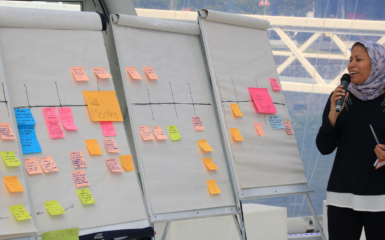
Are We Adapting? 10 lessons from countries tracking progress on their climate change adaptation efforts
By Patrick Guerdat, Policy Advisor, NAP Global Network, International Institute for Sustainable Development
How do we know if National Adaptation Plans (NAP) are making a dent in reducing vulnerability? NAP progress reports play a critical role in assessing a country’s climate change preparedness and advising on next steps. They consolidate the information gathered from monitoring, evaluation, and learning (MEL) activities and encourage countries to continuously learn, adapt, and improve on their climate change adaptation efforts.
Adaptation in Biennial Transparency Reports: Frequently Asked Questions
By Jeffrey Qi and Emilie Beauchamp
Under the Paris Agreement’s Enhanced Transparency Framework (ETF), countries have the option to report on climate change impacts and share information on adaptation efforts. As many countries are preparing their first Biennial Transparency Report (BTR), the NAP Global Network answers some common questions on how to prepare the adaptation chapter of the BTR and how they can leverage the outputs and results of the National Adaptation Plan processes.
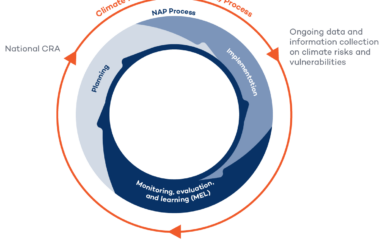
Four Ways to Link Climate Risk Assessments With the Evaluation of National Adaptation Plan Process
By Julie Dekens, Principal Researcher, NAP Global Network, IISD
Explore the four key avenues that countries should use to strengthen the links between their national Climate Risk Assessments and the evaluation of National Adaptation Plan processes.